DOAP vs DOPS in CBME: A Practical Guide for MBBS Students
Competency-Based Medical Education (CBME) asks a simple question: Can you actually do what a doctor needs to do, safely and consistently?
Just like learning any psychomotor skill e.g riding bicycle, you cannot learn riding bicycle just by reading books on it. Some expert will demonstrate and you will observe ,assist then perform.
In Medicine, it is done in proper systematic way, two powerful tools help you get there: DOAP and DOPS. This article explains both, shows how they fit together, and gives you real-life general surgery examples to make your learning smooth, confident, and clinic-ready.
What Are DOAP and DOPS?
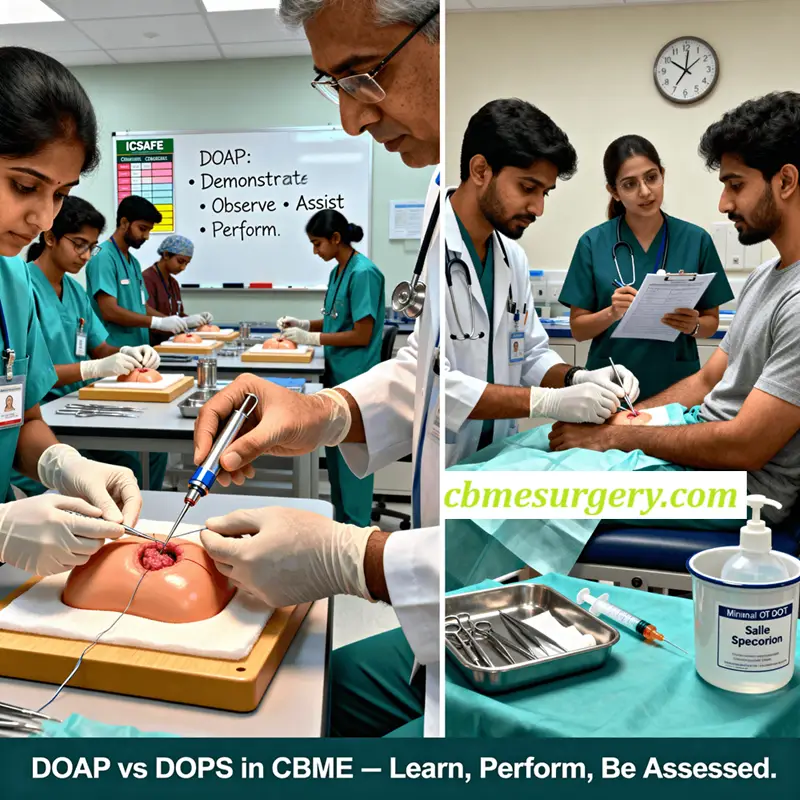
DOAP: Demonstrate–Observe–Assist–Perform
- A structured method to learn procedural skills step-by-step.
- Flow:
- Faculty Demonstrates the skill (ideal technique).
- You Observe actively (with a checklist).
- You Assist (handle instruments, help with steps).
- You Perform (first on models/task trainers, then on real patients under supervision).
Think of DOAP as your “learning pathway” from not knowing to doing.
DOPS: Direct Observation of Procedural Skills
- A workplace-based assessment where an assessor observes you performing a real procedure on a real patient (or sometimes in a high-fidelity sim) and gives structured feedback.
- Short (10–20 minutes), focused, with ratings and immediate feedback.
Think of DOPS as a “snapshot assessment plus coaching” of how you actually perform.
Why They Matter in CBME
- CBME focuses on outcomes: not just “knowing” but “doing.”
- DOAP builds your skill in a safe, staged way.
- DOPS verifies and improves your performance in real clinical settings.
- Both align with Miller’s Pyramid:
- Knows → Knows How → Shows How (DOAP in skills lab) → Does (DOPS in real practice)
Where You’ll Use DOAP and DOPS in General Surgery
Common MBBS-level general surgery skills suited to DOAP and DOPS include:
- Surgical hand scrub, gowning, and gloving
- Asepsis and sterile field setup
- Instrument handling and knot tying
- Local anesthesia infiltration
- Simple interrupted suturing of superficial wounds
- Incision and drainage (I&D) of a superficial abscess
- Wound dressing, suture removal, and drain removal
- Nasogastric (Ryle’s) tube insertion
- Basic pre-op counseling/consent for minor procedures
- Documentation and safe surgery checklist use (adapted for minor procedures)
Your institution’s exact list may vary—follow local curriculum and supervision policies.
The DOAP Method: Step-by-Step (with Real Examples)
1) Demonstrate
- Faculty performs the procedure at full speed once, then repeats slowly explaining each step, highlighting:
- Indications/contraindications
- Consent and communication
- Equipment and setup
- Asepsis and analgesia/anesthesia
- Stepwise technique
- Troubleshooting and complications
- Aftercare and documentation
Example (General Surgery): Simple interrupted suturing of a 3-cm clean forearm laceration in the casualty.
- Faculty demonstrates:
- Hand hygiene, sterile glove
- Wound assessment, irrigation with saline
- Local infiltration of lignocaine (check for allergy)
- Proper instrument handling (needle holder, toothed forceps)
- Needle entry at 90°, eversion of wound edges, spacing/placement, knot security
- Dressing and advice (analgesia, warning signs, review for suture removal)
- Documentation in case sheet
2) Observe
- You watch actively using a checklist. Tip: Stand where you can see hand–instrument coordination.
- Ask clarifying questions after the demo: “Why choose 3-0 nylon here?” “How do you achieve eversion?”
3) Assist
- You hold instruments, retract, cut sutures, open sterile packs correctly.
- You practice parts of the task: placing one suture on a model; infiltrating local on a sim pad.
- Faculty corrects your grip, angles, and force.
4) Perform
- You perform the entire procedure, first on a task trainer/manikin, then on a patient with close supervision.
- Faculty observes and gives targeted feedback.
Real-life scenario (I&D of a small abscess):
- Demonstrate: Site marking, LA infiltration in a diamond pattern, incision over maximal fluctuation, breaking loculations, irrigation, packing, dressing, advice.
- Observe: Note ergonomics, incision length, safe instrument use.
- Assist: Pass instruments, help with irrigation and packing.
- Perform: You do the procedure on a model or with supervision in minor OT.
A Helpful Universal Mnemonic: I C S A F E
Use this for any procedure to structure your thinking:
- I – Indications and contraindications
- C – Consent and patient communication
- S – Setup and equipment check
- A – Asepsis and anesthesia/analgesia
- F – Focused technical steps (the procedure)
- E – End steps: aftercare, documentation, disposal, patient advice
Write ICSAFE on your pocket card. It keeps you safe and systematic.
DOPS: How It Works (And How to Ace It)
What Is Assessed
A typical DOPS form covers:
- Pre-procedure: indications, consent, patient ID, positioning
- Technical skills: instrument handling, tissue respect, flow, economy of movement
- Asepsis and safety: sterile technique, sharps handling
- Communication: explains to patient, reassures, responds to discomfort
- Professionalism and teamwork
- Post-procedure: hemostasis, dressing, waste disposal, documentation, advice
- Overall performance and readiness for independent practice (at the undergraduate level: “with supervision”)
The DOPS Encounter (10–20 minutes)
- Choose a suitable case (appropriate complexity for your level).
- Confirm consent (patient and assessor).
- Perform the procedure while the assessor observes silently.
- Receive immediate feedback (3–5 minutes): what you did well, what to improve, agreed action points.
- Get the form signed and file it in your logbook/e-portfolio.
Feedback Styles You’ll Encounter
- Pendleton’s model (start with what went well → what could be improved → action plan)
- SBI/A (Situation–Behavior–Impact/Alternative)
- Ask–Tell–Ask (your self-assessment → faculty tips → your plan)
Tip: Come with a self-assessment ready; it makes feedback sharper and more constructive.
DOAP vs DOPS at a Glance
Aspect | DOAP | DOPS |
Purpose | Teaching/learning method | Workplace-based assessment and feedback |
Context | Skills lab + supervised clinical | Real patient care (or high-fidelity sim) |
Timing | Early to intermediate learning | Intermediate to advanced (verification) |
Focus | Stepwise acquisition | Performance in context (holistic) |
Tools | Checklists, demonstrations, task trainers | DOPS form with ratings + feedback |
Feedback | Continuous, coaching-style | Short, structured, immediate |
Outcome | “Shows How” → ready to attempt on patients | “Does” → confirms readiness with supervision |
They complement each other: DOAP builds the skill; DOPS refines and validates it.
Putting It Together: A Simple Learning Pathway in General Surgery
Week 1 (Skill Lab Focus)
- DOAP: Hand scrub, gown, glove; basic instrument handling; knot tying; local anesthesia on sim pad; simple interrupted sutures on foam/pig’s foot/synthetic pad.
- Micro-DOPS (formative on simulators) to practice feedback style.
Week 2 (Minor OT/OPD)
- DOAP: Wound assessment and irrigation; dressing technique; suture removal; drain removal.
- Assisted cases in minor OT under supervision.
Week 3 (Ward/Emergency)
- DOAP: NG tube insertion; IV cannulation (if part of local curriculum); documentation and consent.
- Begin DOPS on simple suturing, suture removal, dressing.
Week 4 (Consolidation)
- DOPS: At least 2–3 observed encounters across different procedures (e.g., suturing a superficial laceration, suture removal and dressing, NG tube insertion).
- Reflection: Write what improved, what to practice next.
Note: Numbers and schedule vary by institution; follow local policies.
Tips to Excel (Student Playbook)
- Before the case:
- Revise steps using ICSAFE; visualize the procedure.
- Check equipment yourself—don’t assume it’s all there.
- Introduce yourself to the patient; gain trust early.
- During the case:
- Narrate key steps briefly to your assessor (“Now I’ll irrigate with copious saline…”).
- Mind ergonomics: patient height, your posture, instrument handling.
- Be gentle, respect tissues, and be safe with sharps.
- After the case:
- Give clear post-procedure advice in simple language.
- Document concisely but completely.
- Ask for one actionable improvement if time is short.
- Practice routine:
- 10–15 minutes daily on knot tying and suturing on a pad improves your DOPS performance dramatically.
- Video yourself (if allowed) on a task trainer; compare to faculty demo.
Bringing It All Together: A Student-Centered View
- DOAP is your roadmap for learning a procedure safely and correctly.
- DOPS is your chance to show you can do it with a patient—and to get targeted coaching.
- In general surgery postings, combine both:
- Learn in the lab → assist in minor OT → perform under supervision → get observed and coached via DOPS.
- Keep your learning active: checklists, reflections, and small daily practice add up to big gains.
Take-Home Messages
- Use ICSAFE for any procedure: Indications, Consent, Setup, Asepsis/Analgesia, Focused steps, End with aftercare and documentation.
- Treat DOAP as your practice ladder and DOPS as your performance mirror.
- Focus on asepsis, tissue respect, communication, and documentation—they’re universally assessed.
- Build confidence with repetition on task trainers, then transfer to patients under supervision.
- Ask for feedback; own your action plan; track progress in your logbook.
• Is DOAP only for simulators?
No. It often begins in the skills lab, but the Assist and Perform stages transition to real patients under supervision.
• Is DOPS pass/fail?
It’s primarily formative. Repeated DOPS build a reliable picture of your competence. Some programs also use it summatively—check your local policy.
• What if I get nervous in DOPS?
Everyone does at first. Use ICSAFE as your mental checklist, narrate calmly, and focus on safety. Assessors are there to help you improve.
• What counts most in DOPS—speed or safety?
- Safety and systematic technique. Efficiency comes with practice, but never at the cost of asepsis or patient comfort.