
Surgery OSCE- Sterile Dressing
How to Practice?
You Can Practice the sterile dressing procedure over mannequin in presence of your friend who observes you with a timer and opening checklist in his mobile. He clicks on the steps performed by you and final store automatically comes . In case of non-availability of mannequin ,procedure can be practiced by preparing a model of limb by using long and thin carton box and covering it with cotton & sheet of cloth.
In case you are alone , you can switch on your mobile in recording mode then perform the procedure. Later you can analyze it and click on checklist points.
Practice the procedure as you are doing really in ward using verbal instructions wherever required.
Practicing the procedure multiple times builds your muscle memory which is essential to develop a psychomotor skill.
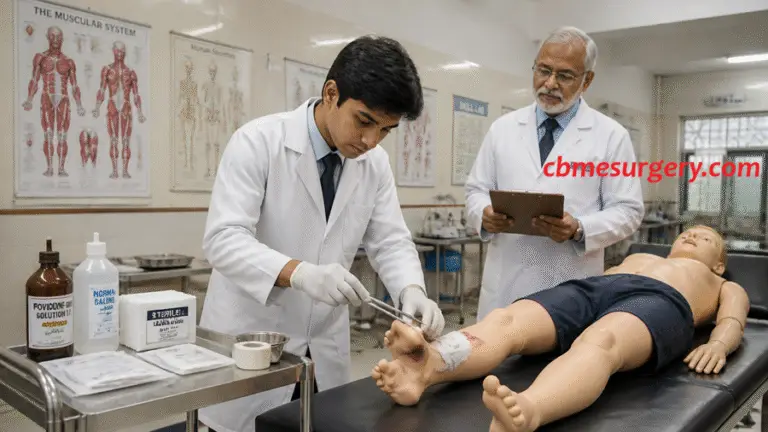
OSCE Station: Sterile Dressing of a Wound
For MBBS students · Surgery · CBME · OSCE skill assessment
Domains assessed: Cognitive & Psychomotor (14 marks) + Affective (10 marks) = 24 marks
Station Details
| Station type | Observed Structured Clinical Examination |
| Topic | Sterile Dressing of a Wound |
| Target learners | MBBS students (Phase II / III) |
| Time | 10 minutes |
| Subject | Surgery (CBME SU6.5) |
Learning Objectives
- Demonstrate sterile dressing technique for a clean wound.
- Apply principles of asepsis during the procedure.
- Identify wound status and select appropriate dressing.
- Communicate respectfully and take informed consent.
- Maintain patient privacy, empathy, and safety.
Cognitive & Psychomotor Domain – Checklist
Tick each step the candidate performs correctly.
| ✓ | Checklist item | Marks |
|---|---|---|
| Introduces himself/herself to the patient | 1 | |
| Explains procedure to patient and obtains verbal consent | 1 | |
| Performs hand hygiene (hand wash / alcohol rub) | 1 | |
| Prepares sterile dressing trolley & identifies sterile field | 1 | |
| Opens sterile pack without contaminating inner contents | 1 | |
| Opens inner pack and pours antiseptic solution aseptically | 1 | |
| Dons sterile gloves correctly (cuff not touching bare skin) | 1 | |
| Removes old dressing using sterile forceps & scissors without touching wound, bandage/changes gloves if any unsterile part touched | 1 | |
| Inspects wound and verbalises findings (colour, discharge, oedema, granulation) | 1 | |
| Cleans wound from centre to periphery using separate swab for each stroke | 1 | |
| Discards used swabs into yellow waste bag after each stroke | 1 | |
| Applies fresh sterile gauze without touching wound-facing side | 1 | |
| Secures dressing with micropore tape or bandage (adequate, not tight) | 1 | |
| Disposes biomedical waste correctly (yellow / black bags) | 1 |
Maximum: 14 marks | Passing: ≥10 (70%)
Affective Domain – Attitude & Communication
Select the rating that best describes the candidate's behaviour.
| Excellent (2) | Satisfactory (1) | Unsatisfactory (0) | Item | Marks |
|---|---|---|---|---|
| Greets patient, introduces self, and takes verbal consent | 2 | |||
| Ensures patient privacy (curtains, draping) | 2 | |||
| Explains the procedure in simple, lay terms | 2 | |||
| Shows empathy – asks about pain / discomfort during procedure | 2 | |||
| Maintains calm, respectful, and reassuring communication throughout | 2 |
Maximum: 10 marks | Passing: ≥6 (60%)
Scoring Summary
This OSCE station can be used for formative or summative assessment in Surgery clinical postings.