
Advanced Trauma Life Support (ATLS) for MBBS Students
History of ATLS
The James Styner Story
The Advanced Trauma Life Support program emerged from a tragic yet transformative event in 1976. Dr. James Styner, an orthopedic surgeon from Nebraska, was piloting his family on a trip when their small aircraft crashed in a cornfield in Nebraska. The crash resulted in:
- Death of his wife
- Serious injuries to his four children
- Dr. Styner himself sustained critical injuries
When they reached the local hospital, Dr. Styner was shocked by the inadequate trauma care. The emergency physician lacked proper trauma training, and there were no established protocols for managing multiple trauma victims. This experience made Dr. Styner realize that trauma patients in rural and even urban hospitals were receiving suboptimal care due to lack of standardized training.
Development into a Worldwide Course
Following his recovery, Dr. Styner collaborated with the American College of Surgeons (ACS) to develop what would become ATLS:
- 1978 – First ATLS course conducted in Auburn, Nebraska
- 1980 – ACS officially adopted ATLS as a national program
- 1980s – Rapid expansion across the United States
- 1990s – International expansion began
- Present – ATLS is taught in over 60 countries worldwide
Key Milestones:
- Over 1 million healthcare providers trained globally
- Regular updates every 4 years based on evidence-based medicine
- Currently in its 11th edition (2025)
- Recognized as the gold standard for initial trauma management
ATLS Approach to Patient Management
Core Philosophy
ATLS follows a systematic, prioritized approach based on the principle that “the greatest threat to life is addressed first.”
What is killing patient?
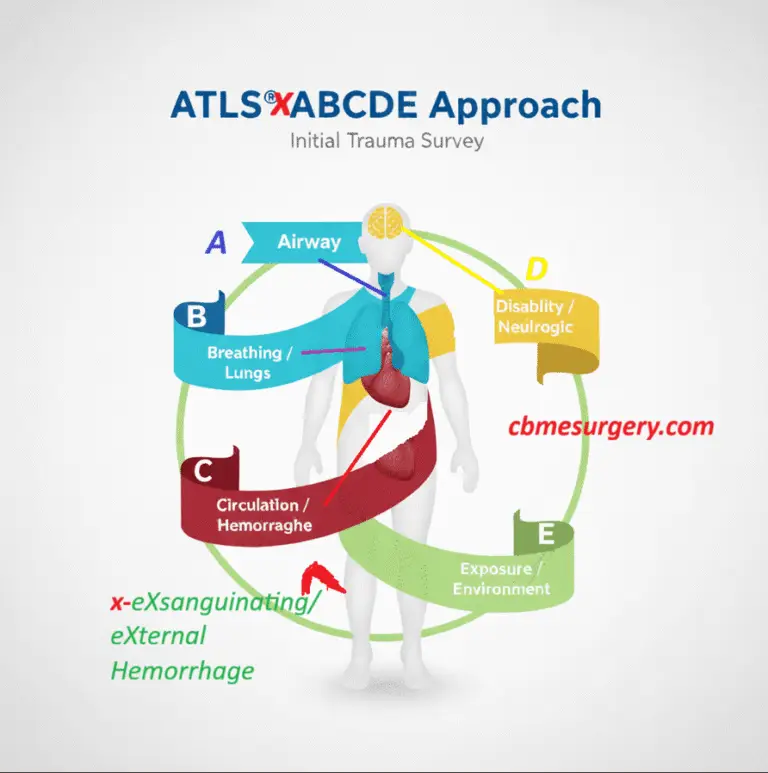
The xABCDE Approach( ATLS 11th edition)
- x- eXsanguinating eXternal hemorrhage
- A – Airway (with cervical spine protection)
- B – Breathing (ventilation and oxygenation)
- C – Circulation (with hemorrhage control)
- D – Disability (neurological assessment)
- E – Exposure/Environment (complete examination and temperature control)
Identify life threatening & then limb/organ threatening conditions as soon as possible and do necessary interventions without waiting for investigations. e.g in case of absent breath sounds on hemithorax, tachypnea, tracheal shifting to other side ,Do needle thoracostomy/ICD without waiting for X-ray Chest
Pre-hospital Care Guidelines
Scene Safety and Assessment
- Ensure scene safety for responders
- Rapid scene survey and mechanism of injury assessment
- Call for appropriate resources (air ambulance, specialized teams)
Pre-hospital ABCDE Management
Airway:
- Open airway using jaw thrust (not head tilt-chin lift if C-spine injury suspected)
- Clear visible debris
- Consider basic airway adjuncts (oropharyngeal/nasopharyngeal airways)
- Advanced airway only if trained and necessary
Breathing:
- High-flow oxygen for all trauma patients
- Identify and treat tension pneumothorax
- Seal open chest wounds
Circulation:
- Control external bleeding with direct pressure
- Establish IV access if possible
- Fluid resuscitation (limited in penetrating trauma)
- Pelvic binder for suspected pelvic fractures
Disability:
- Rapid neurological assessment (GCS)
- Maintain spinal immobilization
Exposure:
- Prevent hypothermia
- Rapid trauma survey
Transport Decisions
- Load and Go situations:
- Airway compromise
- Hemodynamic instability
- Altered mental status
- Significant mechanism of injury
Management at Tertiary Care Center
Preparation Phase
- Pre-arrival notification from EMS
- Activate trauma team
- Prepare resuscitation bay
- Ensure equipment readiness
Primary Survey (First 2-5 minutes)
A – Airway Assessment:
- Speak to patient (if responsive, airway is patent)
- Look for obstruction, facial fractures, neck hematoma
- Management: Jaw thrust, suctioning, definitive airway if needed
- Always maintain C-spine immobilization
B – Breathing Assessment:
- Look: chest movement, respiratory distress, cyanosis
- Listen: breath sounds bilaterally
- Feel: chest wall integrity, subcutaneous emphysema
- Immediate life threats to identify:
- Tension pneumothorax → Needle decompression/ICD
- Open pneumothorax → Occlusive dressing
- Massive hemothorax → Chest tube
C – Circulation Assessment:
- Pulse quality and rate
- Blood pressure
- Capillary refill
- Skin color and temperature
- Hemorrhage control:
- Direct pressure
- Tourniquet for extremity bleeding
- Pelvic binder
- Identify need for blood products
D – Disability Assessment:
- Glasgow Coma Scale
- Pupillary response
- Gross motor and sensory function
- Blood glucose level
E – Exposure:
- Complete undressing
- Log roll for back examination
- Prevent hypothermia with warming measures
Secondary Survey
Only after primary survey is complete and patient is stable
- History (AMPLE):
- Allergies
- Medications
- Past medical history
- Last meal
- Events leading to injury
- Head-to-toe examination:
- Systematic examination of all body regions
- Neurological assessment
- Appropriate imaging studies
Key ATLS Guidelines and Principles
Resuscitation Guidelines
Fluid Resuscitation:
- Initial bolus: 20 mL/kg crystalloid (pediatric), 1-2L (adult)
- Blood transfusion if no response initial crystalloid
- Massive transfusion protocol when indicated
Blood Product Ratios (Massive Transfusion):
- PRBC : FFP : Platelets = 1:1:1 ratio
- Goal: damage control resuscitation
Imaging Guidelines
Primary Survey Imaging:
- Chest X-ray
- Pelvic X-ray
- C-spine imaging
- e-FAST (extended-Focused assessment with sonography for Trauma)
Secondary Survey Imaging:
- CT scan (when patient is stable)
Definitive Care Priorities
- Damage Control Surgery (if indicated)
- Transfer criteria to higher level of care
- Disposition planning
Special Considerations
Pediatric Modifications
- Weight-based medication dosing
- Different normal vital signs
- Consider non-accidental trauma
Elderly Patients
- Comorbidities affect response
- Medications (anticoagulants)
- Lower physiological reserve
Pregnancy
- Maternal stabilization is priority
- Left lateral positioning
- Early obstetric consultation
Conclusion
ATLS represents a paradigm shift in trauma care, transforming it from an unorganized response to a systematic, evidence-based approach. The program’s success lies in its:
- Standardized methodology
- Global applicability
- Regular updates based on evidence
- Emphasis on teamwork and communication
As future physicians, mastering ATLS principles is crucial for providing optimal trauma care and potentially saving lives in critical situations.
Remember: “The first hour after injury is the most critical – what you do or fail to do during this time can determine whether the patient lives or dies.”