
SU7.1 Describe the Planning and conduct of Surgical audit
Note on sources: the competency text below follows the NMC CBME Volume III (Surgery, Topic SU7.1).Evidence cited is from standard textbooks (Bailey & Love, Sabiston) and widely cited reviews (Cochrane audit and feedback review, WHO checklist studies)
Decoding the Competency
CBME Competency Spotlight: SU7.1 — Describe the Planning and conduct of Surgical audit
Domain: Knowledge (K) Level: KH (Knows How) Core Competency: Yes Vertical Integration: Community Medicine
Assessment Method: Written / Viva Voce
Describe-student must explain the process in sequence and in their own words, not merely list.
Planning is everything before data collection (topic, standard, team, ethics).
Conduct is data collection, comparison with standard, change and re-audit.
Competency spotlight
Why this competency? Every Indian Medical Graduate will work in a hospital, PHC or CHC where outcomes are measured. You will be asked, “How good are we?” Audit is how a team answers honestly.
What you should know
- Audit = measuring practice against an agreed standard, changing it, and measuring again.
- It asks “Are we doing what we should be doing?” Research asks “What is the right thing to do?”
- The cycle has six steps; the last step (re-audit) is the one most often skipped.
- Audit is about systems, not blaming individuals.
How you will be assessed: a 5-mark short note (“Describe the steps of surgical audit”), a viva question (“Give an example of an audit you could do in the ward”), and MCQs on the audit cycle.
Audit cycle in daily life
“You order food on a delivery app. It arrives late and cold. What happens next?” (rating, complaint, the restaurant changes the packing, rating is checked again). That is an audit cycle in daily life.
Learning outcomes : by the end, you can (1) define audit, (2) draw the audit cycle, (3) plan a simple ward audit, (4) Differentiate audit from research.
What is surgical audit?
Definition. Surgical audit is the systematic, critical analysis of the quality of surgical care, including procedures used for diagnosis and treatment, use of resources and outcomes, with the aim of improving practice (Bailey & Love, chapter on surgical audit / evidence-based practice; clinical audit definition used by NICE and the UK Department of Health).
Audit Vs Research
Feature | Audit | Research |
Question | Are we meeting the standard? | What is the best practice? |
Standard | Already exists | Created by the study |
Patients | No change in care | Randomised or exposed |
Ethics committee | Usually registration with the clinical governance / audit cell | Mandatory approval, consent |
Result | Local action | Generalisable knowledge |
Why audit? (the “5 A’s”) Accountability, Assurance of safety, Assessment of resources, Agreed standards, Advancement of learning.
Everyday analogy: A school exam result analysis. The teacher compares marks with the expected pass percentage (standard), finds weak topics (gap), re-teaches (change), and sees the next test (re-audit).
What does the evidence say?
- WHO Surgical Safety Checklist (Haynes et al., NEJM 2009): in eight hospitals worldwide, major complications fell from about 11% to 7% and deaths from about 1.5% to 0.8% after introduction. Subsequent systematic reviews and meta-analyses of checklist studies (for example Bergs et al., Br J Surg 2014) support reductions in complications and mortality, with the best results when implementation quality is audited.
- Lancet Commission on Global Surgery (2015): advises that every country should track surgical volume, perioperative mortality and access; audit is part of a national surgical plan.
.
Planning and conduct, the core of SU7.1
Stage 0. Planning (before the cycle starts)
- Choose the topic. Pick something common, high-risk, high-cost, or problem-prone, and measurable. Examples: surgical site infection after hernia repair, time from admission to appendicectomy, antibiotic timing, theatre cancellations.
- Form the team. Surgeon, resident, nurse, anaesthetist, a records / data person, a hospital administrator. A senior sponsor protects the project.
- Register the project with the hospital audit / quality cell; arrange confidentiality of patient data (use hospital number or code, not names).
- Define the standard. Standards come from guidelines (WHO, Surgical Infection guidelines, national bodies) or local consensus. Phrase it as a measurable target, for example: “100% of elective clean surgeries receive prophylactic antibiotic within 60 minutes before incision.”
- Define criteria, sample size and time frame, and the data collection form.
The six stops of the cycle
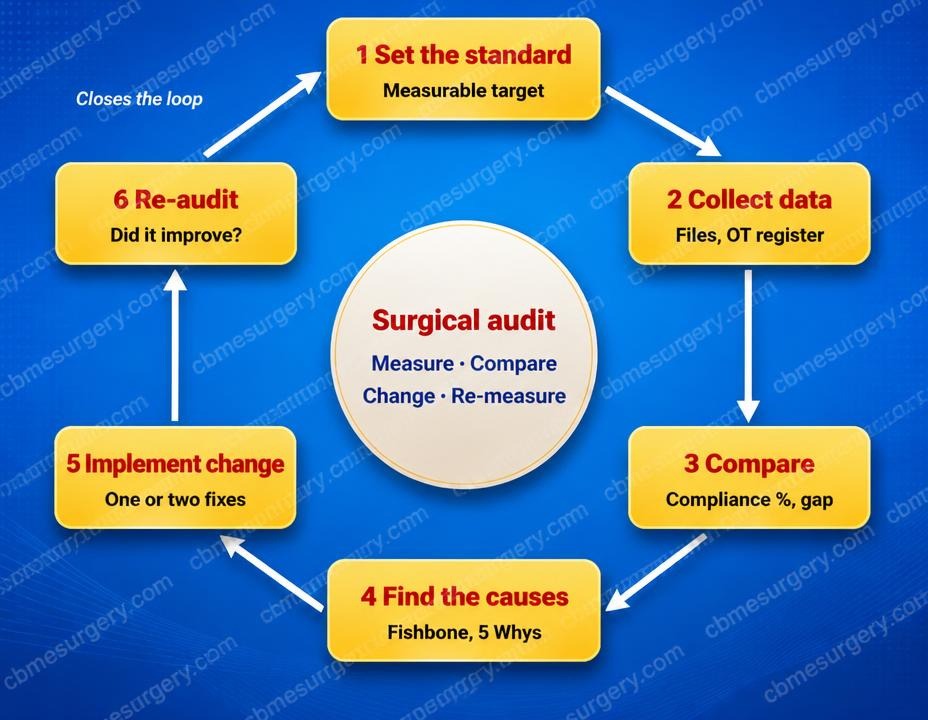
- Select topic and set the standard.
- Collect data (prospectively is better than retrospectively; from case files, OT registers, anaesthesia charts, electronic records). Use a pilot of 10 files to test your form.
- Compare with the standard. Calculate compliance (%), and find the gap.
- Analyse causes of the gap. Use simple tools: fishbone (cause-effect) diagram, “5 Whys”.
- Implement change. One or two realistic changes: a reminder sticker on the OT list, antibiotic given in the pre-op holding area, a nurse responsible for time-out.
- Re-audit after a defined interval. Did compliance rise? If yes, sustain; if no, revise the intervention.
Bailey & Love principle: audit data should be accurate, complete and fed back to those who can change care. Sabiston similarly emphasises risk-adjusted outcome measurement, and that raw mortality rates without case-mix adjustment can mislead.
Types of audit
- Structure audit: staffing, equipment, OT availability.
- Process audit: what was done (antibiotic timing, checklist use, DVT prophylaxis).
- Outcome audit: what happened (SSI, mortality, return to theatre, length of stay).
- Donabedian model: Structure leads to Process, which leads to Outcome.
- By scale: individual surgeon, unit, hospital, regional, national (NCEPOD, NSQIP, registries).
- By time: retrospective, concurrent, prospective.
- Morbidity and Mortality (M&M) meeting: a form of case-based audit with a no-blame discussion.
Tools: audit proforma, OT register, SSI surveillance (CDC definition: superficial, deep, organ-space, within 30 days), risk scores (ASA grade, POSSUM, P-POSSUM, NSQIP calculator) for risk adjustment.
Key concept, risk adjustment. A tertiary referral unit that operates on sicker patients may show a higher mortality than a district hospital, yet may be doing better. (Analogy: comparing the batting average of an opener on a green pitch with a lower-order batsman on a flat pitch.)
Worked example and student activity
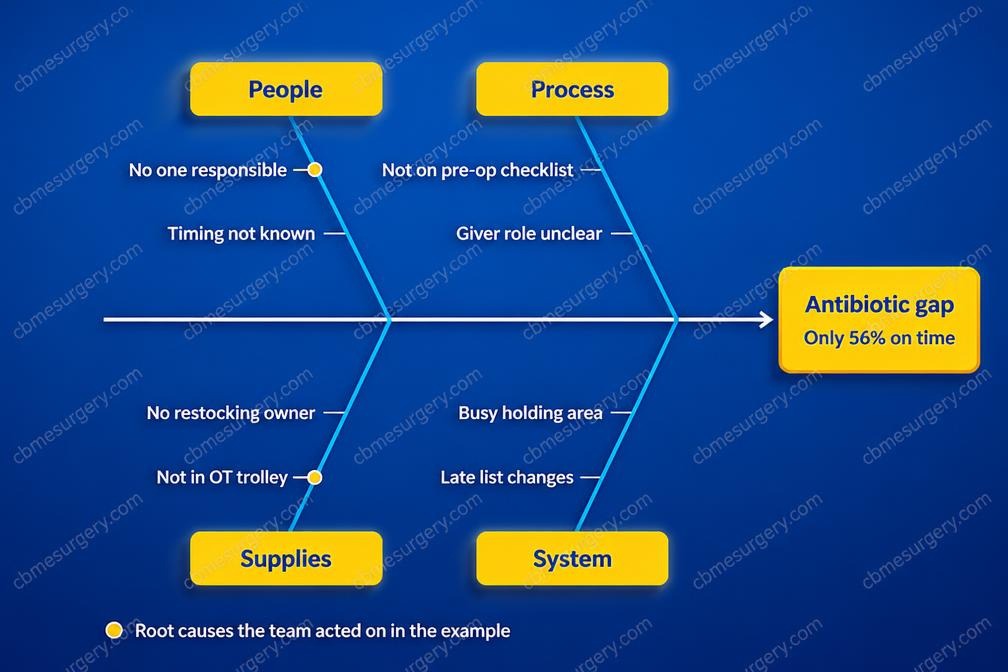
Example: Antibiotic prophylaxis audit in elective lap cholecystectomy (a case you can run in your own ward)
Step | Content |
Standard | A single dose of cefazolin or equivalent within 60 min before incision in 100% of clean-contaminated cases (check local guideline for lap cholecystectomy) |
Data | 50 consecutive cases from OT register and anaesthesia charts |
Result (illustrative) | 28/50 (56%) received it on time; 14 got it after incision; 8 got none |
Gap | 44% |
Cause | No named person responsible; drug not in OT trolley |
Change | Antibiotic added to the pre-op checklist; nurse in holding area gives it |
Re-audit | 3 months later: 45/50 (90%) |
Why audits fail
- The loop is never closed (no re-audit): the commonest failure.
- Poor data quality; incomplete records.
- Wrong standard, or too many standards at once.
- Fear of blame; defensive reporting.
- No leadership or time.
- Confusing audit with research.
Ethics and law
- Confidentiality: anonymised data.
- Audit uses data already generated from routine care and does not change patient treatment; where it does, treat it as research and obtain Institutional Ethics Committee approval (ICMR National Ethical Guidelines).
- No-blame, learning culture; but professional misconduct is dealt with through proper channels.
- Link to AETCOM: honesty, accountability, patient safety.
Summary, quiz, take-home
Summary in one line: Audit = Measure, Compare, Change, Re-measure.
Take-home message: “If you do not measure it, you cannot improve it, and if you do not re-measure it, you do not know you improved it.”
Five-minute quiz
- The step of the audit cycle most commonly missed is: (a) set a standard (b) collect data (c) re-audit (d) analyse. Answer: c
- Audit differs from research because it: (a) needs randomisation (b) compares practice to an existing standard (c) always needs a control group (d) tests a new drug. Answer: b
- “Does the ward give antibiotics within 60 minutes before incision?” is what type of audit? Answer: process audit
- In Donabedian’s model, the three components are: Structure, process, outcome
Assessment bank
Describe the planning and conduct of a surgical audit.
Model answer outline: definition , planning (topic, team, standard, tool) , audit cycle with diagram , re-audit and feedback, example.
Short answer questions
- What is a surgical audit? How is it different from research?
- Draw the audit cycle.
- Give an example of a standard and how you would audit it.
- What is meant by closing the audit loop?
- What is an M&M (mortality & morbidity) meeting?
References:
- National Medical Commission. Competency Based Medical Education Curriculum for the Indian Medical Graduate, Volume III (Surgery, Topic SU7.1).
- Williams NS, O’Connell PR, McCaskie AW (eds). Bailey & Love’s Short Practice of Surgery 28th edition. Chapters on audit, evidence-based practice and quality in surgery.
- Townsend CM et al. Sabiston Textbook of Surgery 22nd edition . Chapters on quality, outcomes, patient safety and surgical outcomes research.
- Ivers N, et al. Audit and feedback: effects on professional practice and healthcare outcomes. Cochrane Database Syst Rev 2012;(6):CD000259 (and its 2025 updates).
- Haynes AB, et al. A surgical safety checklist to reduce morbidity and mortality in a global population. N Engl J Med 2009;360:491-9.
- Bergs J, et al. Systematic review and meta-analysis of the effect of the WHO surgical safety checklist on postoperative complications. Br J Surg 2014;101:150-8.
- Dindo D, Demartines N, Clavien PA. Classification of surgical complications. Ann Surg 2004;240:205-13.
- Donabedian A. Evaluating the quality of medical care. Milbank Mem Fund Q 1966;44:166-206.
- Meara JG, et al. Global Surgery 2030 (Lancet Commission on Global Surgery). Lancet 2015;386:569-624.
- National Institute for Health and Care Excellence. Principles for Best Practice in Clinical Audit.
- National Ethical Guidelines for Biomedical and Health Research Involving Human Participants, 2017.